

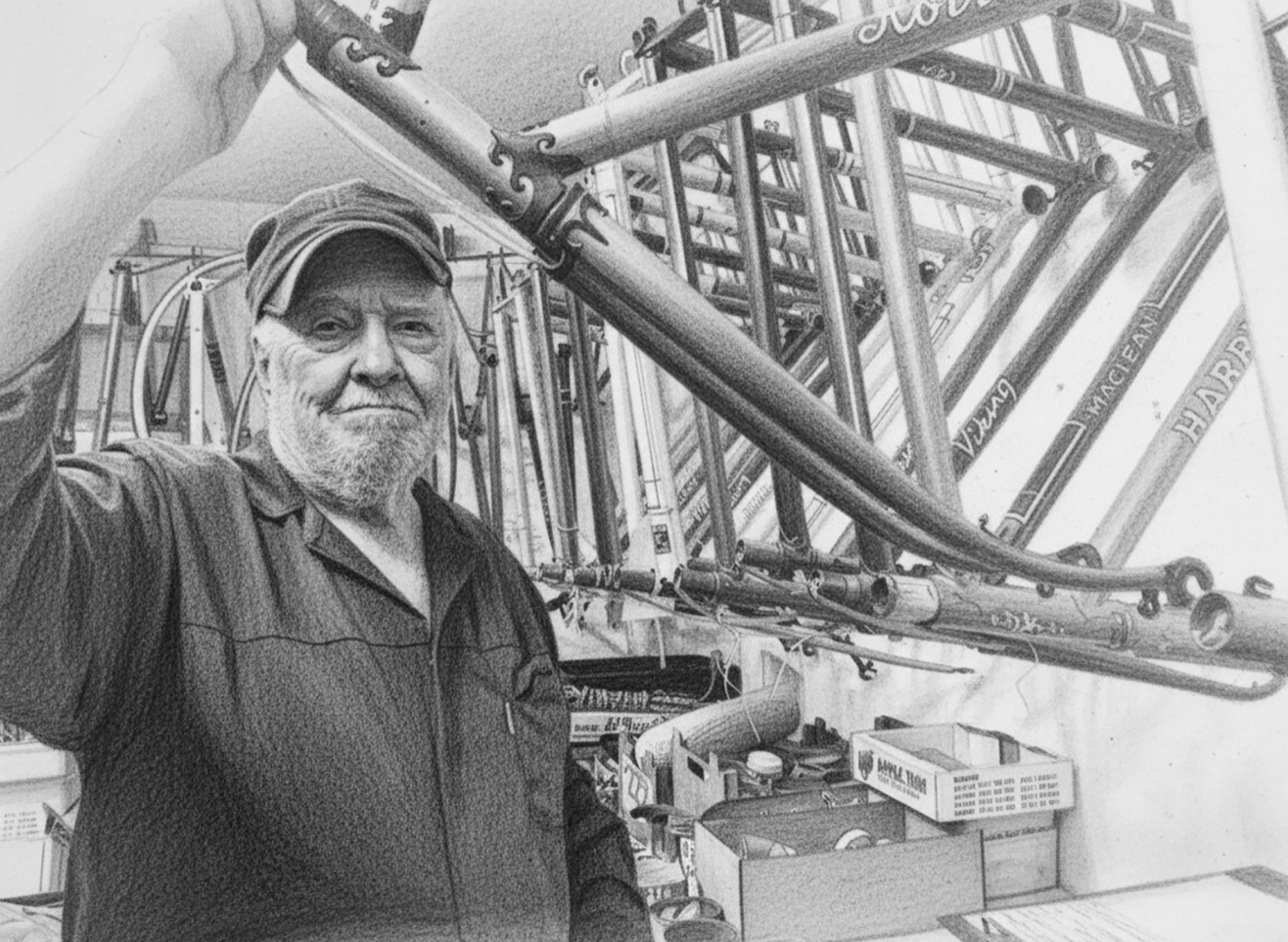
Cyc-Ous, A Million Bikes, SRAM and YOUR Local Bike Shop (Part 3/3)
Actually, that headline is more of an announcement…. an index of “Things to Come.” We’ll cover the above topics, perhaps in separate postings, later and in no particular order, as the one leads on from the other.
But right away let me introduce three names and topics which have much to do with the first three entities/projects in the headline above.
Namely Cyc-Ous, The Million Bike Project and the SRAM connection.
The first, Cyc-Ous, still exists and there is a blog by that name which, if you google it, you will find is about vintage steel bikes (mostly).
The second, the Million Bike Project owes its concept to Cyc-Ous (mostly)
But the Million Bike Title has been “purloined”. And the culprit is SRAM. This is the story…
The Cycle Trade and Qhubeka /SRAM connection story.
One name introduced here you will know (SRAM) and the other probably not – that of F.K. Day. (who is the co-founder of SRAM).
Mr. Day is a very clever man. There is an American “opportunist” marketing term that may be familiar…. “See a gap in the market and take it”. Here is the marketing gap Mr. Day saw.
Shimano, was originally – and still is – a fishing reel company. They then developed a bicycle add-on product… derailleur gears. They were the first bicycle parts producers to introduce into the bicycle marketplace the brilliant marketing concept of Gruppos.
Previously and right up until the 1950s on the Continent, the Bicycle Rrade had been made up of two parts – frames and parts. Separate. There was a problem here as there was no universal standardisation of sizing. This applied to both tubing and threads.
What frame makers did to overcome this problem was sell a frame complete with headset, seat post, BB, chainring and cranks. These parts were mostly sourced from bicycle parts manufacturers, each specialising in a producing a particular product.
So, the Bicycle Trade was diversified into many companies, each competing for business in their particular sector. The producers of saddles, bars and stem, brakes, wheels, freewheel and chains supplied either a parts wholesaler or direct to the retail shop you bought your bike from.
There were thousands of these small family shops – even the smallest village had one. Indeed, many a small town had a frame-builder. These shops mostly bought the parts needed to build up a bike from a wholesale chain using a catalogue to order, utilising the dependable, fast, efficient postal service; the goods being returned the same way.
Trade and communication – in Europe as elsewhere – relied on an effective postal service.
The Origins of and Motivation for GRUPPOS…
Fast forward to modern times and Shimano in Japan shrewdly realised the win-win distribution chain advantages of a frame-maker in being able to also offer a complete bike. The buyer could then buy a complete ready-to-ride machine, serviced and supplied by the shop he bought it from.
At first a Buyer had choice of a range of brands at a shop, but later single-brand shops were established too.
For the bike shop, having a complete bike to sell was a convenience and time-saving solution that solved the size differentiation and parts purchase dilemma. However, the real sell-in advantage was to the frame manufacturer since he made a profit on both the parts and frame.
All well and good, but here came the problem for Shimano and Campagnolo. Their production was hard-put to keep up with supply to the large frame-makers like Giant. Campagnolo turned to sub-contracting smaller operations like Gipiemme, Ofmega and Misch to produce enough parts for them.
In the meantime, in the United States, shortages of supply capacity meant that neither the wholesalers nor the smaller frame-builders could get parts to complete bikes.
Previous to this, the American company, Specialized, pioneered a different concept, designing parts in the States and having them manufactured in Taiwan. In contrast, the superior design and quality Suntour brand derailleurs needed a distribution chain. So they helped open Bridgestone sales in the States.
That still did not help the thousands of independent shops.
Day saw the gap. He decided on Quality rather than Quantity as a launch platform. Quantity requires big investment in tooling and long lead times. He would take on Shimano and Campagnolo at the Top End.
He would manufacture in China, control quality and sell at top-end prices. Sell quality at premium price. Manufacture at economic cost and make big margins. Optimistic endeavors like this require foresight, determination and a willingness to take risks.
Having identified the target market as small frame-builders and retail shops, the first thing Day had to do was produce a premium-priced, quality product to offer. If your opposition can’t supply, you start off running.
But here is the genius way Day introduced the product to the market: He hired 400 people – many of them top-class cyclists – to drive to shops and frame-builders, each being allocated a territory local to him.
Each SRAM representative had a boot full of SRAM parts, an incentive to offer to the buyers and an attractive commission for deals done. Before Campag or Shimano knew what hit them SRAM, had established a firm base which the two leaders could do nothing to counterattack.
To get exposure, SRAM made deals with European and fledgling American Pro cycling teams to ride bikes fitted with SRAM components.
Now we come to Motivation and the “Charity Connection” aspect…
Let’s look at a South African example .
Douglas Ryder had been unsuccessful in approaching MTN with a sponsorship deal for his team. He had no exposure milage plan to offer. Everyone knew what MTN did. All mobile service providers did much the same.
In marketing, one looks for a USP – a Unique Selling Proposition – a benefit to differentiate your product or service from that of the opposition offering.
The medical doctor wife of Qhubeka’s Ant Fitzhenry, Carol Austin, had acquired the SA rights to the Carmichael System and SRM Power Measurement. She monitored the training and performance of Ryders’ team members, and they adjusted their training accordingly.
There were already European teams riding ProTour events on the Continent being sponsored by a charity. ONCE, the Spanish charity for the blind, being the most prominent.
Ryder proposed that MTN sponsor his team with a dual pitch:
- An aim to have an SA-based squad ride to Tour de France but, mainly…
- The world-wide TV coverage and thus awareness for the MTN support of Qhubeka upliftment initiative, that of helping children in rural areas get a better education by providing bicycles as transport to get them to distant schools.
MTN sponsored the team for eight years but unfortunately for both, them and Qhubek were forced to discontinue sponsorship the year before the team rode the Tour de France due to financial constraints.
None-the-less the Universal exposure of the name Qhubeka did a marvelous awareness job for the initiative and it’s benefit to humanity aims.
MOTIVATION
In my own Incentive Motivation Business as Motive Force, I have often advocated/lobbied for Win-Win “Alliances”.
Over the years at my company, Motive Force, I had always stressed the Power of Selling the Benefit over the “Application”.
To give an analogy: an electric drill enables one to drill holes faster. Yes. True.
But -beyond that, the purpose of a hole might be that you need to affix a hook in order to hang something.
Some other (converse) analogy examples: The ghost writer for two of Lance Armstrong’s books was brilliant in devising the titles of both.
The second book’s title was “Every Second Counts”. Wannabe punters bought it thinking it provided the Secret Formula for Going Faster.
Instead, it advocated “Slow down, smell the roses. Life is short. Enjoy!”
But the first book title was the real show-stopper: “It’s NOT about the bike!”
Huh? It’s actually about the man (or woman) riding the bike and, in particular, the intent and mindset of the pedaller. Both books peddled the concept “Pause for Thought” to pedal people.
Where are you going? How do you get there? i.e. Motivation.
Motivation, the motive power movement (mpm) and Qhubeka.
Now we come the mpm, the concept that followed on from my Incentive Motivation business, Motive Force.
Even before those two Armstrong books appeared, we had arrived at the….
“Sell the Benefit, not the Mechanism*” analogy.
*“It’s not the drill but the need for the holes”.
The bicycle was the *Mechanism. But this was merely a means-to-an-end in the same way that a better education gives access to a better job.
All the great charitable organisations in the world – Rockerfeller, Carniegie and even Gates decided to give away what they had spent their whole life chasing
Why?
Perhaps the deciding factor stems from a belated realisation, by people who had made money, that their legacy would be that of the selfish accumulation of personal wealth… unless they changed that to something that benefitted some people.
Perceived Altruistic Actions by companies still active is justified in win-win situations. The MTN/Qhubeka cycling team is an example.
To illustrate a slight variant motivation aspect: Motive Force, as a member of the board of trustees of Afribike, had approached the then government under Thabo Mbeki via Dullah Omar the then Minister of Transport with a project to provide bicycles to get rural kids to school.
The motivational reasoning was irrefutable. Bussing children to school in urban areas was feasible, if at huge cost to the country. The cost of busses is subsidised to private owners who are more than adequately compensated for fuel, maintenance and all expenses.
Busses pick up children, take them to school, park there until it is time to take scholars home. (Something not entirely rational there for a start?)
In rural areas, poor roads and route planning problems preclude bussing. Where the road infrastructure is poor there are few cars. A child riding a bike is thus safer.
However, and in addition, the right sort of bike could utilise a footpath shortcut across the veld.
The idea of The Million Bike Project that was presented to, and accepted by, the whole cabinet under the Shova Kalula banner as a presidential [priority] project. It was to be a 50/50 Public/Private sector, Rand-for-Rand joint initiative.
The plan was that every year, for 10 years, 100 000 bikes would be delivered, in batches of 1000 bikes, to each of 100 Rural Region Schools. Afribike undertook to find the private sector portion.
Zuma played the Ethnic Card and rallied the numerically superior Zulu element of the ANC conference at Polokwane to oust the predominantly Xhosa Mbeki cabinet.
Most of those projects initiated by the former cabinet were terminated. This included the Million Bike project but not Shova Kalula that Afribike initiated. A government department was set up to house it.
At that stage I approached Ant Fitzhenry of Axiz with a proposal that he be one of the sponsors of a private sector initiative I had envisaged to supplant it.
The demise of Afribike and the Origins of mpm/Qhubeka
Ant is another shrewd operator who saw in my motive power movement proposal as a win-win opportunity. The government had instituted certain criteria that companies were required to comply with before companies could expect to be recognised as a supplier.
One was BBBEE and another was that the company was to have a Social Upliftment Project component.
So, what Ant did was take on the Bikes for Kids project as the Axiz Social Upliftment element.
But here is where the win-win becomes a win-win-win exercise.
Taking a leaf from the MTN sponsorship rationale, Ant realised the value of goodwill potential of being able to tell Axiz customers of the Upliftment Project the company was engaged in.
Here’s where the SRAM connection comes in.
SRAM and the creation of World Bicycle Relief Project
In the December of 2004, a tsunami hit Indonesia. FK Day, through his bike-maker connections, was able to supply bikes as essential transport to victims the devastated area. This led to him creating World Bicycle Relief.
He knew exactly what we had created here in SA. He approached Ant with this proposition: WBR in Africa would concentrate on countries North of the Zambesi, whilst Qhubeka would do so for those countries to the South.
We, Qhubeka, were working through prototype bike designs and selected the latest prototype which WBF chose to call the Buffalo for production. By joining forces we both benefited from greater quantity order pricing, preferred treatment etc.
All well and good.
When quality control became an issue and I was called in to tell SRAM – who were placing the orders – what needed sorting. Assembly of the SA side, then as now, is in (what was) Northern Transvaal. SRAM had a man in SA and that person became the Overall CEO of the WBR project.
Then Ant found that SRAM was charging Qhubeka a premium. So, the association ended.
So now we come to SRAM now.
I just picked up on Facebook that WBR has announced to the world at large the attainment of “Their” One Million Bike Target (still using the Buffalo Bike apparently). Well bully for them, “Hip-Hip Hooray” and all that.
In my opinion (and one that I feel entitled to express – as being an instigator of the concept) Ant has strayed from the pathalong the way.
One “deviation/dead-end detour” was to set up a robotic frame factory in the Eastern Cape.
If you need electric drills to drill holes you don’t need to set up a factory to make them.
You need jobs for people, not machines and AI to supplant humans. The factory failed for a variety of reasons.
To go back to basics …
At Afribike we marketed the Million Bike Pilot Project to government as a means to:
- solve transport problems, offering bicycles as a go-anywhere, anytime, economic and environmentally friendly alternative solution… where applicable.
- An educational path out of poverty for rural children.
All credit to Ant. It is he that has taken a concept to fruition and Qhubeka has delivered over 110 000 bicycles – so far.
Qhubeka has designed and is making a unique machine here in SA. The beauty of the design is that it’s square tubing construction can be put together by hand using local workers trained for the job.
The machine uses long-lasting, lubricant-infused, plastic-type bearings instead of metal ball bearings in the headset and BB. Enough units have been out in the veld for long enough to have proved effective.
However, that initial aim of qualifying pupils for getting a white-collar job has, in my opinion, now been superseded by a more urgent need. Youngsters with Matric cannot find a job.
If you give a young man training in a manual skill, like plumbing, brick laying, carpentry, electrical work and yes bicycle repair, you equip that person with the means to earn a living.
What we need in SA are skills Ttaining facilities. In KZN, near Margate, a Swiss charity funded such a facility.
To impart those skills, 400 young men were enrolled as students. They were to be housed in dormitories and fed over the six months course period. With such skills there would be enough work in their own communities to make a living. Unfortunately, Covid killed the scheme.
At 88 my job is to try to alert folk to the need to revive such initiatives.
To end this piece on an upbeat note, I am speaking to someone in Elgin now who has already begun an initiative along these lines.
How did Ron’s writing’s end up here? Here’s how.
Ron’s previous columns:
Disclaimer: the opinions and views of Ron Thompson are not necessarily those of TREAD Media.

