

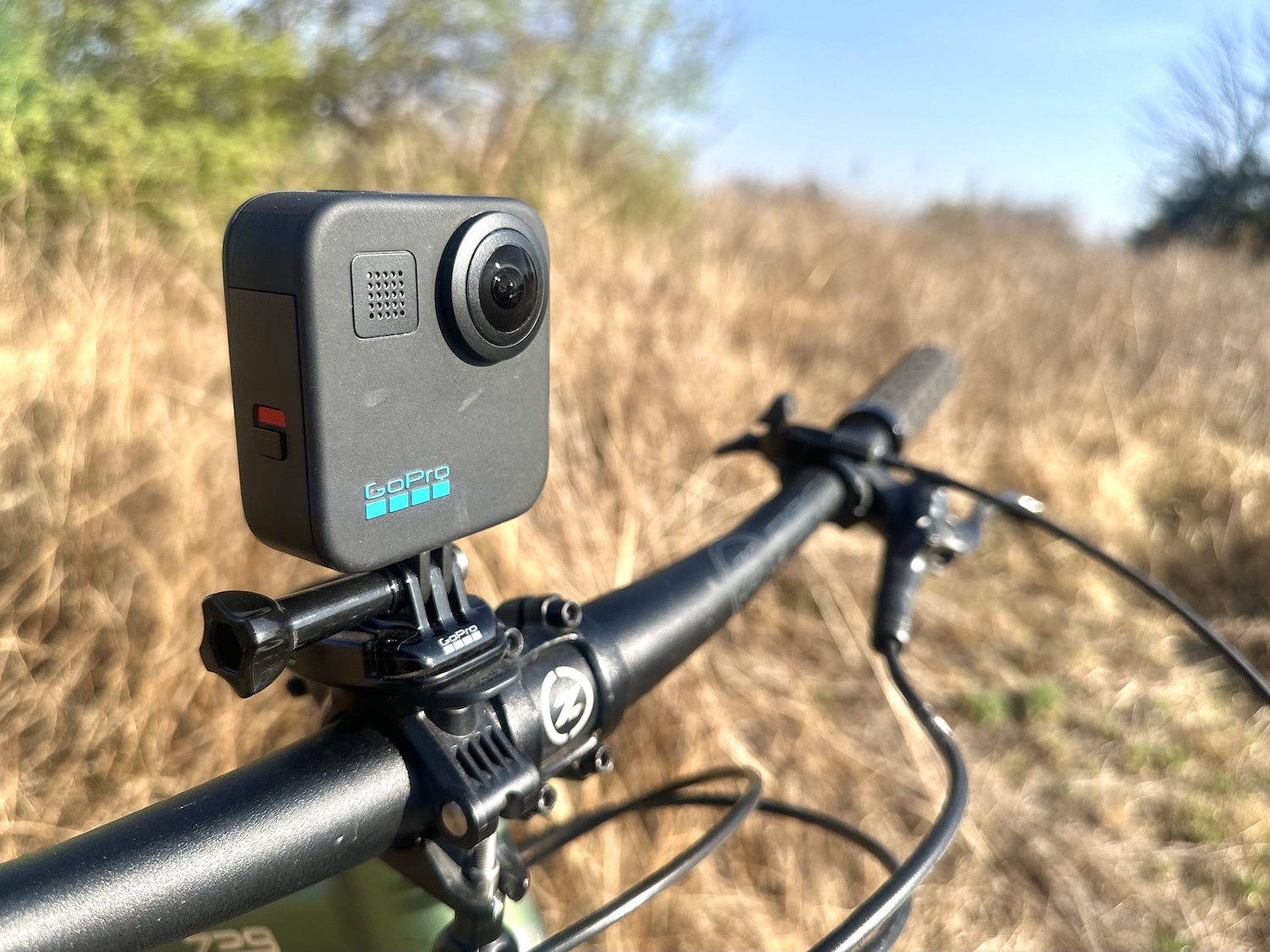
Our team’s first taste of a 360-degree POV camera began with high levels of anticipation. And to be honest, the levels never really dropped throughout our test period because the captured content is always impressive. Here’s a summary of our experience with the GoPro MAX 360.
A conventional POV action camera makes you decide what you want to film before you start riding. The GoPro MAX takes a different approach: capture the scene in 360 degrees and decide where you want the camera to look afterwards.
For mountain bikers, that opens up some interesting possibilities. Instead of committing to a forward-facing view, the camera captures the rider, trail and surrounding scenery at the same time. The result is a different type of POV footage, with much more freedom when it comes to choosing the final shot.
We put the GoPro MAX to work on mountain-bike trail rides and events, including the 2026 KAP sani2c and 2026 Standard Bank Berg & Bush, using mostly handlebar but also chest mounts.
WHAT IS THE GOPRO MAX?
The GoPro MAX is a 360-degree action camera that uses two lenses to capture the scene around it. Unlike a conventional GoPro, there’s no need to carefully frame the shot before pressing record. The footage can be reframed afterwards, allowing you to choose the perspective that works best for the finished video.
We tested the original version of the MAX, which is being steadily replaced by the MAX 2 with the main difference being resolution. The original offers 5.6K, while the MAX 2 delivers a full 8K.

SIMPLE TO OPERATE
The MAX is refreshingly straightforward to use. There are only three modes to choose from and two buttons to operate, so our testers found it simple and intuitive.
The modes are:
Video: for conventional video and 360 video. Within Video, you choose between HERO mode (single-lens conventional footage) and 360 mode (5.6K/30 spherical footage).
Photo: for HERO or 360 photos, plus PowerPano panoramic photos.
Time Lapse: includes TimeWarp for moving/stabilised time-lapse footage and conventional Time Lapse for stationary use.
The 360-degree capture also removes one of the usual frustrations of POV cameras: getting the framing right. Once the camera is mounted and recording, you can concentrate on riding rather than worrying about exactly where the lens is pointing.
HANDLEBAR MOUNT WORKED BEST
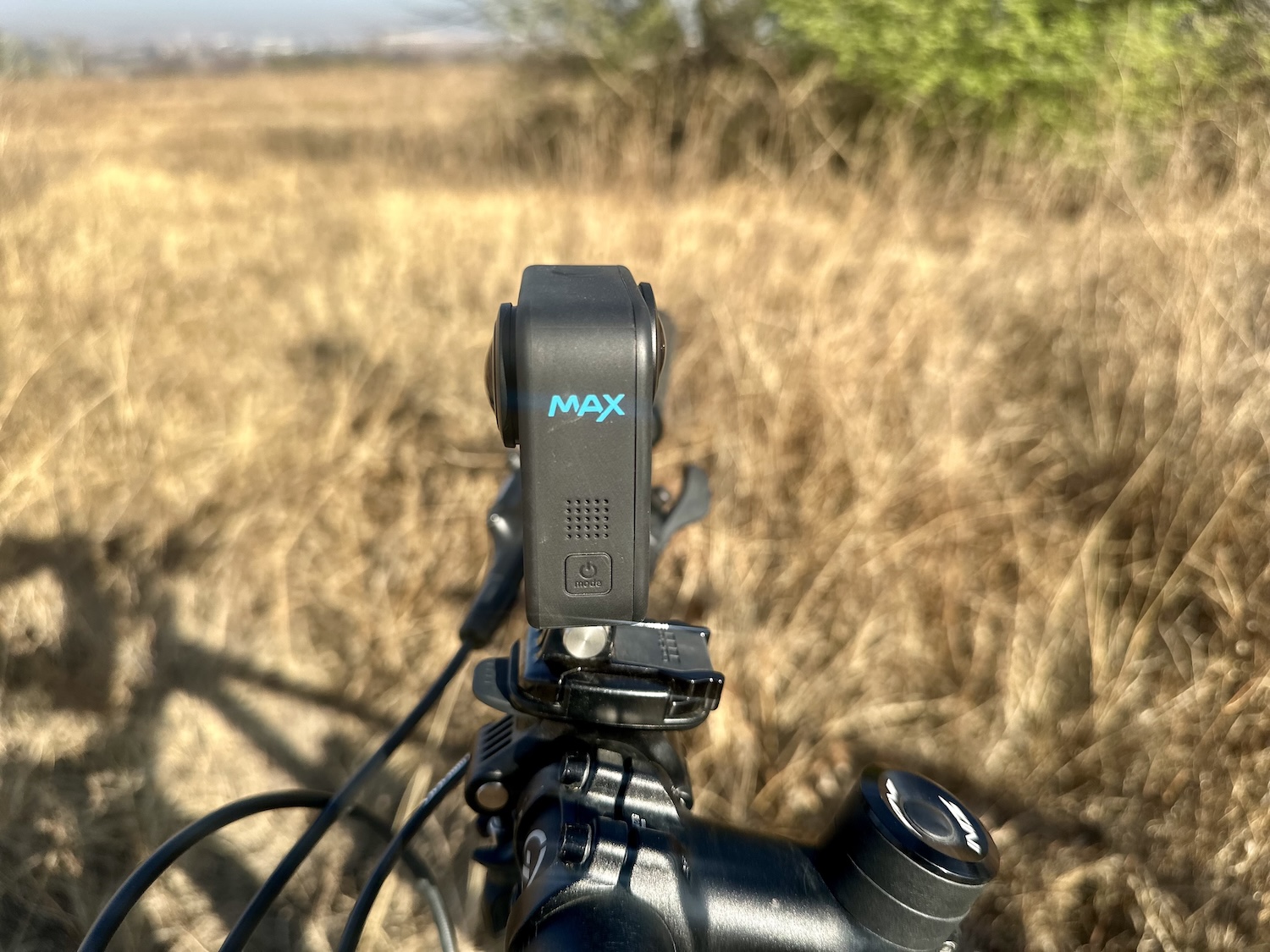
We used the MAX on both the handlebar and chest, with the handlebar position producing the most interesting footage.
Mounted there, the camera captures the rider’s perspective while also showing the trail ahead and what’s happening around you. It worked particularly well for capturing reactions and scenic sections of trail. That ability to capture the rider and environment simultaneously is one of the biggest advantages of using a 360-degree camera for mountain biking.
It also complies with the UCI rule that in a sanctioned race, a POV camera may not be mounted on the rider’s body but is permitted on the handlebar.
IMPRESSIVE IMAGE QUALITY
The overall image quality impressed our testers. The MAX captures a lot of visual information and processes it well, giving you plenty of material to work with when editing and reframing the footage.
It’s a significant advantage of the 360 format: one piece of footage can be turned into several different perspectives afterwards, rather than having to capture each angle separately.

STABILISATION COULD BE BETTER
Stabilisation was one area where the MAX didn’t impress us as much as GoPro’s regular Hero models.
The footage is certainly usable, but our testers found the stabilisation on the conventional Hero cameras better. For riders whose priority is the smoothest possible POV footage, that’s worth considering.
KEEP BOTH LENSES CLEAN
The other issue specific to 360 cameras is stitching. The MAX uses two lenses to create the 360-degree image, and the join between those two images can become noticeable when one lens has collected more dust than the other. That’s particularly relevant to mountain biking, where a dusty trail can quickly turn a clean camera into a dirty one.
It’s therefore worth making lens cleaning part of the pre-ride routine. And repeating this occasionally during the ride. A little dust in the wrong place can become surprisingly obvious in the finished footage.
2D MODE
Used on a chest mount in the 2D mode is an option for the MAX, but that is not its primary purpose. The highest resolution possible in this mode is 1920×1440, which isn’t comparable to a standard 2D POV camera.
EDITING TAKES A BIT LONGER
We used the GoPro Quik app for editing and had no problems clipping and cutting the footage.
The process does take a little longer than working with conventional POV footage, mainly because of the additional reframing required. You have to decide how you want the final shot to look after you’ve captured it.
That’s also where much of the creative appeal lies. Instead of deciding exactly what you want to film before the ride, you can make those decisions afterwards.
BATTERY LIFE
Battery life didn’t cause any concerns during testing. Our testers didn’t find themselves particularly worried about the camera running out of power, so overall battery performance was rated as good for the riding and event use.
VERDICT
See an edited GoPro MAX reel from Sani2c here.
See an edited GoPro MAX reel from Berg & Bush Descent here.
See an edited GoPro MAX reel from Berg & Bush 2-Day here.
The GoPro MAX remains an interesting alternative to a conventional action camera, particularly for mountain bikers who want more flexibility from their POV footage.
Its biggest strength is the ability to capture everything around the camera allowing you to choose the framing later. The handlebar-mounted position proved particularly effective, producing rider-focused footage while still showing the trail and surrounding scenery.
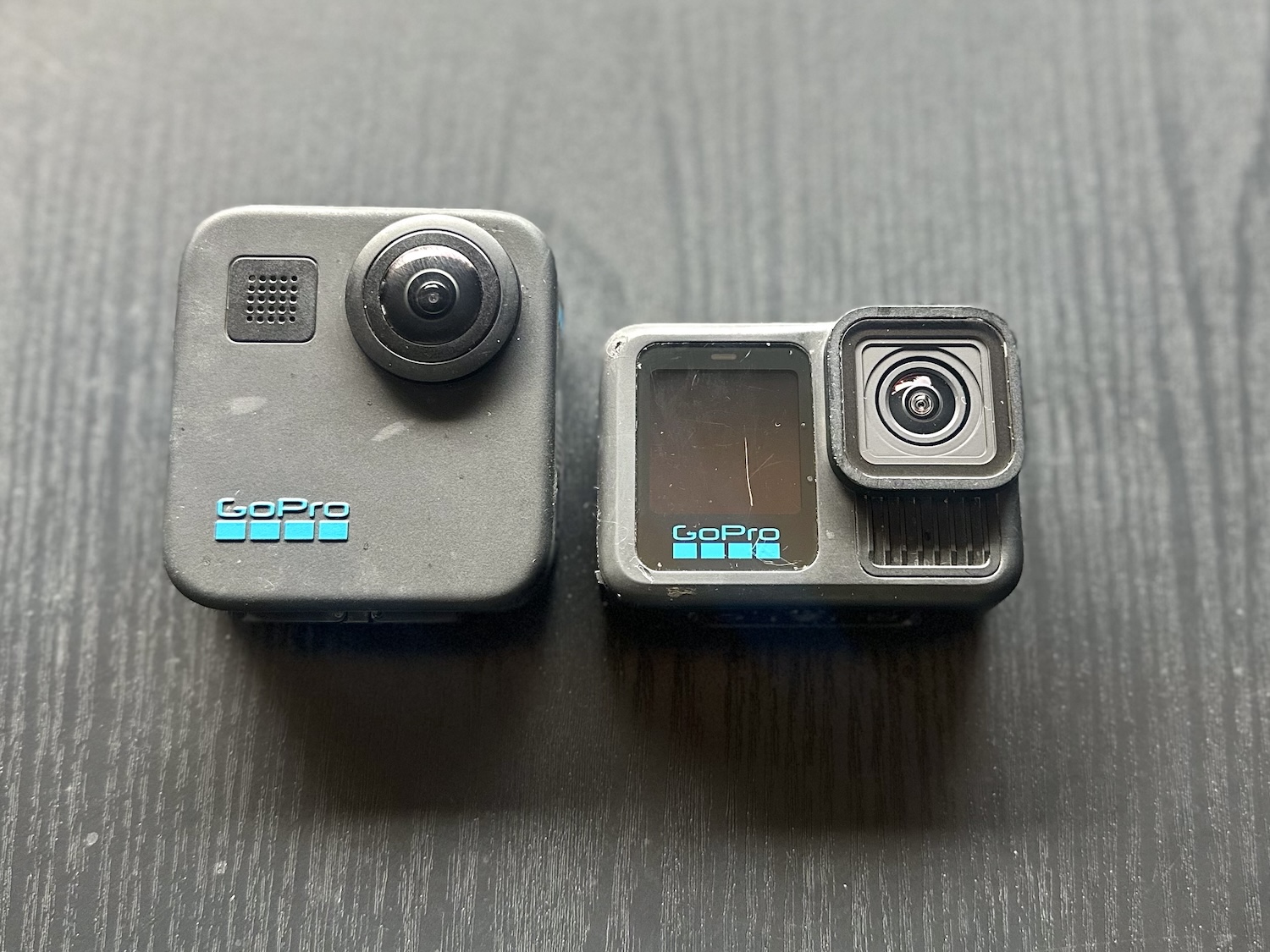
It’s not without shortcomings. The MAX is relatively bulky and heavy compared with some conventional action cameras, the stabilisation didn’t match what our testers experienced from the regular Hero models, and the stitching between the two lenses can become noticeable when one lens gets dirtier than the other.
But if the goal is to capture different mountain-bike footage rather than simply another forward-facing POV video, the MAX offers plenty of creative possibilities. If you already have a regular POV camera, the MAX 360 delivers some new perspectives and should be used to complement your POV camera, not replace it.

What we liked most: The versatility, ease of use and fresh angles offered by 360-degree capture.
What we liked least: Its size and weight, plus stabilisation that didn’t match the regular GoPro Hero models.
Specs:
- Camera: 360-degree action camera
- Lenses: Dual-lens 360-degree capture
- Modes: Three
- Operation: Two physical buttons
- Stabilisation: Max HyperSmooth
- Editing: GoPro Quik app
- Mounts tested: Handlebar and chest
- Primary use tested: Mountain biking POV
- Events tested at: 2026 KAP sani2c and 2026 Standard Bank Berg & Bush
Price: R8999-00
Other GoPro content by TREAD Media:
GOPRO STAYS AHEAD WITH THE NEW HERO11 BLACK & HERO11 BLACK MINI

