

It wasn’t really planned. I decided the day before that I would enter a gravel race to put some of this gravel bike training I have been doing to the test. There’s a big cycling industry focus on gravel racing that I’ve committed to exploring personally. Here’s how my first gravel race went.
By Sean Badenhorst
My son, Cade, was heading out to do a local 80km gravel race and convinced me to join him. I was keen to do a long ride that Saturday and 80km with 1000m of climbing on some different roads made sense. The event was called the Luxliner Magalies Rocks the Cradle. Curious name for a bicycle race, but it was in the region of a small town called Magaliesberg, just over an hour’s drive from home.
I have ridden in that area before in some mountain bike events organised by the same company. I had also done one long gravel ride somewhere there in 2022. I knew to expect some rugged gravel roads.
The race was part of a Landbou Fees (agricultural festival). At the start, the race organiser, Rob Jackson, informed us that the route was actually a bit longer as they had found a way to avoid a long section of tar road. It would be 82km and not 80km.
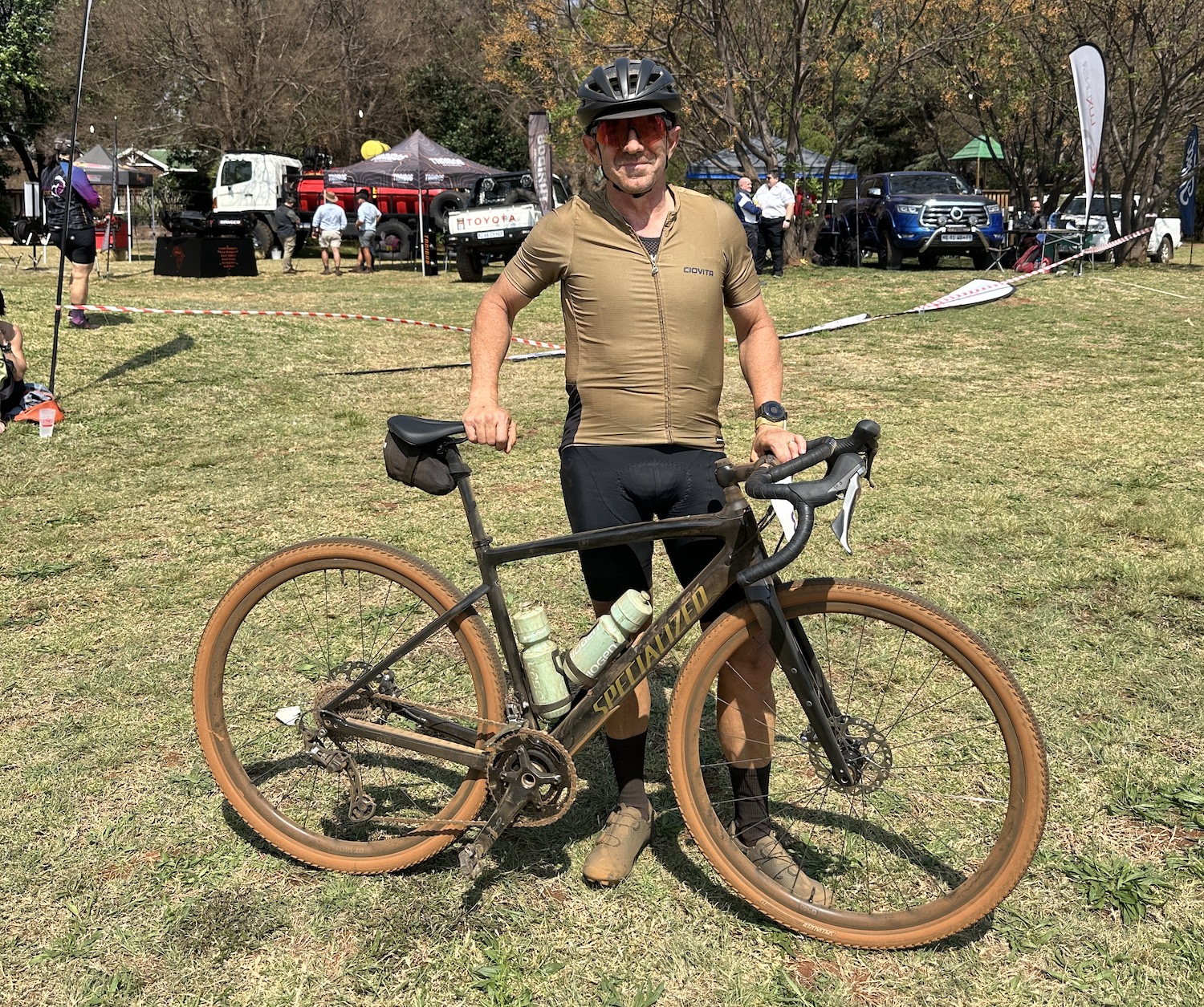
I was on a Specialized Diverge Comp. It’s a lightweight gravel bike with a carbon fibre frame and fork, a carbon DT Swiss wheelset and a mechanical Shimano GRX 2×11 drivetrain. It has a Future Shock 2.0 hydraulic damper in the stem, which offers 20mm of axial compliance when fully open. I had fitted a Farr Aero Gravel Bar because I had been informed that hand discomfort and pain can become the biggest challenge in gravel races.
I had done several rides on this bike so knew some of its limits already. The main one being not unique to this bike, but common to all gravel bikes I have ridden – descents. Not all descents, but long, fast descents that are rutted, sandy, sketchy, rough or stoney – or a combination of those.
After 34 years of mountain biking, where you feel a very high level of control on fast descents, especially on modern mountain bikes, the gravel bike just isn’t even nearly the same. No suspension, narrower tyres, no wide handlebar, no easy-to-feather brake levers, small brake discs with limited-power two-piston calipers. I consider myself an above-average descender of bicycles (road and mountain bike), but I have had some very nervous moments descending fast on a gravel bike. Anyway, back to the race.
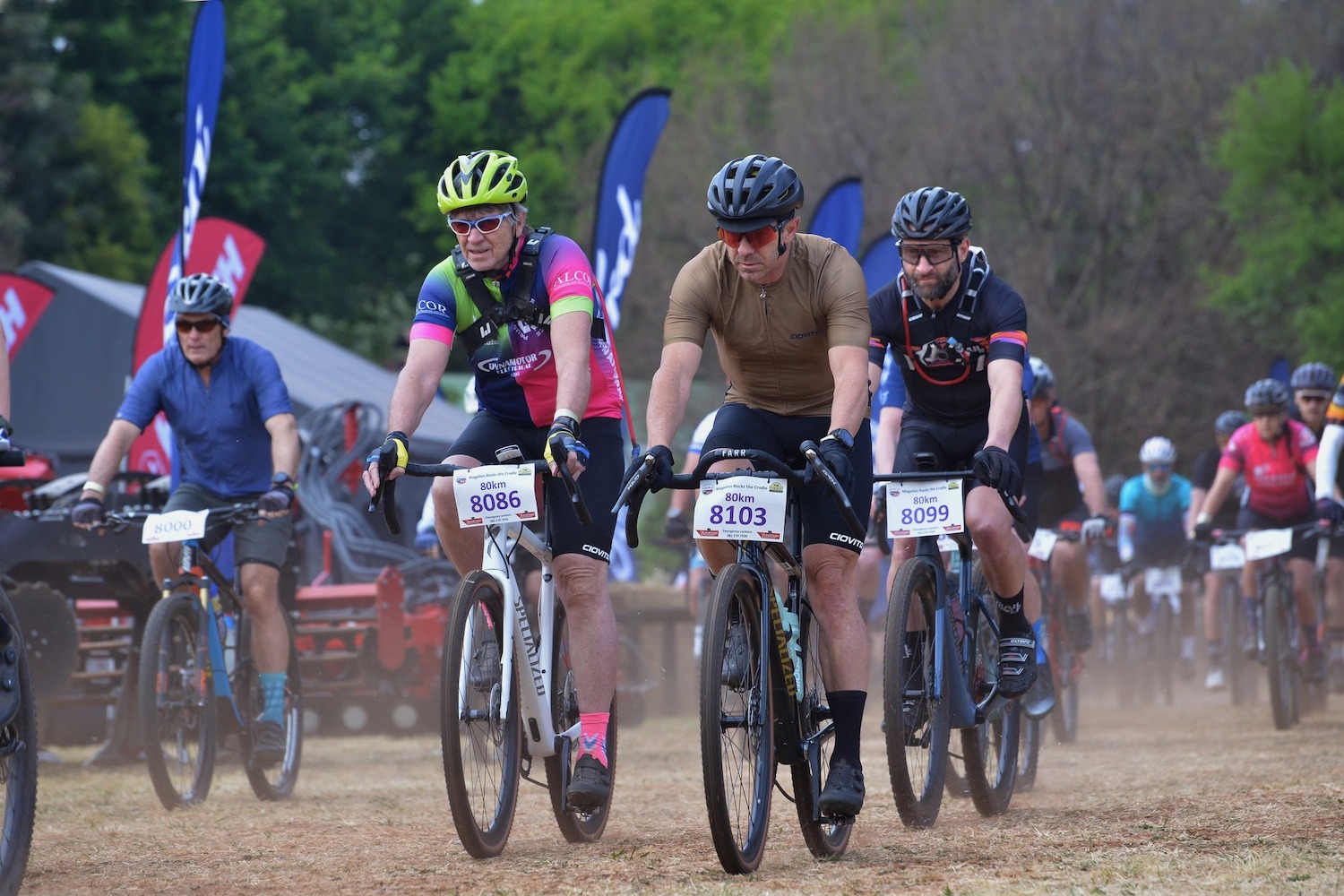
There was a relatively small field and only one large starting group for this particular distance with a mix of gravel bikes, mountain bikes and ebikes. Cade was on a mountain bike – a TREK Supercaliber, which is light, responsive and has suspension (120mm front and 85mm rear). He and a few other young blokes on mountain bikes left the rest of us in the dust on the first moderate descent. It was an uneven farm road with some ruts and stones. According to my Polar, it was only around -4.0% gradient.
I never saw them again! A few mountain bikes were ahead of me because for them, this descent was really not challenging. I tried to brake minimally and, in the process, rolled ahead of all the other gravel bike competitors. But once we had hit some flat and slightly ascending gradients, things changed.
I started to catch and pass riders on mountain bikes due to my more appropriate gearing and faster-rolling bike, while other gravel bike riders eventually caught up to me. They also passed me after a bit because I had worked out that this would not be a bunch race, but an individual time trial with some occasional company. I needed to pace myself in order to have a consistent effort until the finish line.
A few eBikers passed me after about 10km. I assume they were started a few minutes after us because they were charging along.
The gradient varied from flat or slight inclines and declines to rolling. I don’t have a cadence sensor on this bike but focused on keeping a medium cadence of around 80 rpm. I also paid attention to my heart rate as I don’t have a power meter. My maximum HR is set at 187 and I felt that riding in the 150-159bpm range felt both doable and reasonable. I allowed myself to go into the 160s on climbs but tried not to go into the 170s.
There was light cloud cover initially that gave way to blue skies and a warm spring sun. It wasn’t cold, but it did feel quite warm towards the end of the race. I managed my energy consumption by drinking Biogen Cytogen carb drink at regular intervals. After more than 30 years of riding with minimal-to-moderate carbs, I have yet to adapt to what is the new carb-generous training and racing trend.
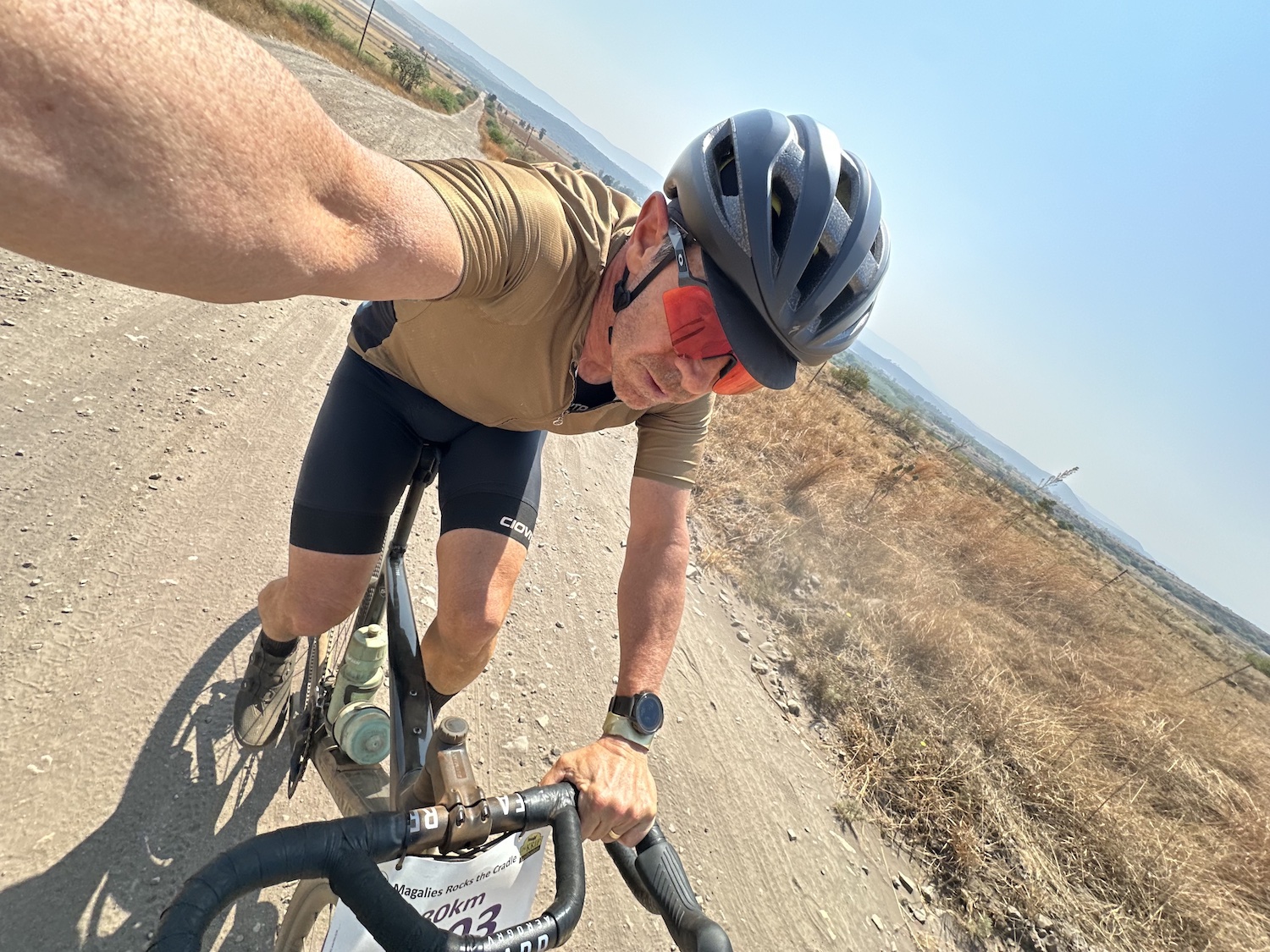
I made the most of the additional hand positions offered by the Farr Aero Gravel Bar. I certainly didn’t get into an aero position because the road surfaces were simply too uneven to risk it. This coming from a former triathlete who is not afraid of riding in an aero position – when it makes sense.
At around 60km I started to feel some fatigue. Just some, which I accepted as earned because my effort had been very consistent. There was quite a long descent from around 60km-65km. The road surface was a bit loose in places and the gradient never more than -10%, but mostly around -4-5%. It’s worth noting that gravel roads are made for motor vehicles and are seldom very steep, especially in this inland region, which is why I really appreciate a 2x drivetrain because it just gives me a good range of gearing to find a comfortable cadence on these moderate gradient routes.
But having to brake on a descent doesn’t come naturally to me, especially a moderate gradient descent that’s wide and predictable. The surface quality of a descent in a gravel race is what dictates how you ride it. I reluctantly braked a few times because I truly felt like I might lose control of the bike. Even with the damper up front fully open and standing on the pedals using my arms and legs for absorption, I felt vulnerable and didn’t want to collect a new batch of roasties or worse, broken bones.
There were a few sharper corners, but once again, gravel roads are made for motor vehicles, so these are seldom tight turns by mountain biker standards. If the surface is smooth (which it wasn’t at this race), you should be able to brake minimally, if at all and use your body position to add weight over the front wheel to prevent it from washing out.
From 65km to the finish, there was mostly climbing. I accepted that the last 20 or so kilometres were going to be tough. I kept drinking, by now from my second bottle and decided that I would use one of the caffeine energy gels I had packed with 20km remaining. It probably helped because I was able to maintain a reasonably consistent effort. Once I reached 72km, I decided to take the other caffeine gel because I was starting to feel spent. I don’t normally ride hard enough or long enough to need energy gels, but had packed two because I was going to a bit of unknown territory at this race.
I expected the last 10km to be fairly straight forward, but man it was tough! A few beastly climbs greeted me, on quite rough-surface roads, which made the going a bit harder.
I snapped a couple of selfies with my iPhone because I needed some sort of visual to go with this article. I also wanted to show the Farr handlebar for our upcoming review of this brand.
The final four kilometres were fairly flat and included a bit of tar before turning into a farm field on a jeep track that felt a lot longer than it was… I was quite relieved to cross the finish line. My time was 03h43m06s. I didn’t feel totally broken, but I was spent.
Looking back, if I asked myself if I enjoyed the race, I would say no. I appreciated the challenge of pacing myself for 82km, but I cannot say that I found any actual joy in doing this gravel race. On the results, it shows that I was eighth overall and second in my age category, Master Men. There were huge gaps between riders. Cade had finished third overall and I was pleased to see his smiling face as I crossed the finish line.
Having raced many road races in my late teens, 20s and 30s, I love the thrill of tactical racing. I expected some of that at least in gravel races, but there was none of that at this race. Sure, gravel races with bigger fields and more age category depth will offer that to some level. With my road racing experience, I’m a master at ‘surfing a bunch’ to save energy. I was hoping for that at this race, but the small field made that impossible. That would have definitely added some fun to this race.
The bike was flawless. It did everything I expected it to. I didn’t experience any lower back or neck ache and my hands actually felt quite normal. I don’t know if this was because of the Future Shock, the Farr Aero Gravel Bar or a combination of those. It also wasn’t the longest race – around half the distance of most South African gravel races, which are 160-180km in distance.
I’m on a forced break from cycling for a few weeks, but will resume my gravel riding/racing mission and enter more gravel races where I hope to find some joy. I’ll let you know how that goes.
Sean Badenhorst started racing bicycles at age 11 – first BMX, then road, triathlon, duathlon, track and all mountain bike disciplines. He’s currently at a stage where he’s looking for more speed, as described here.

